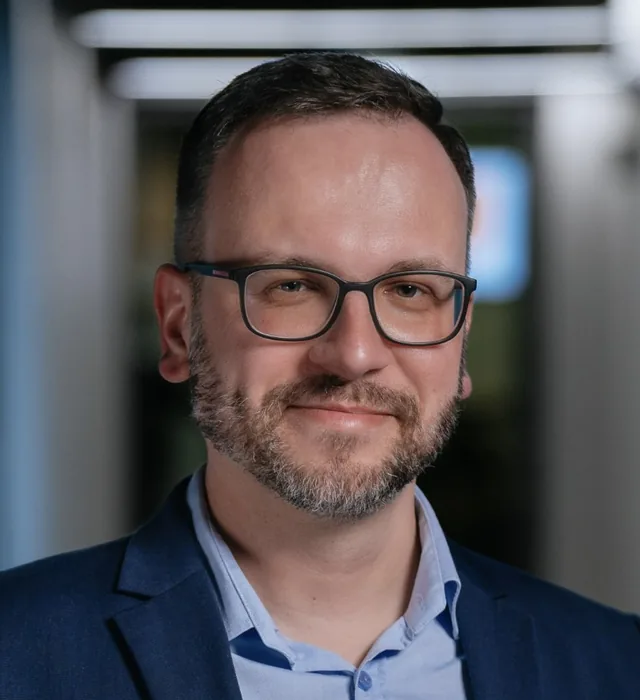
Adam Kuzdraliński, DSc, PhD, Eng · Professor, PJAIT · Warsaw / Lublin

Where and meet.

I am a biotechnologist and bioinformatician. Between 2013 and 2018, I co-founded and developed two technology startups. I led R&D teams, including at Sundose. Between 2024 and 2026, I carried out projects for OpenAI and Anthropic. Today, I head the Department of Bioinformatics and Artificial Intelligence Applications at PJAIT. I also contribute to the European EUonAIR project. I combine experience as a scientist, entrepreneur and team leader.

over 30
peer-reviewed scientific publications
20 yrs
in science and R&D
2
biotech startups where I built laboratories from scratch
Adam Kuzdraliński — portrait
Scroll — DNA transforms into a computer

01 — What to associate me with

Four things worth remembering about me

My work spans DNA technologies, AI safety, bioinformatics education and science communication.

01 Biology → data

DNA as an information medium

Facts

Co-author of a Nature Communications publication (2023) on tagging physical objects with DNA and a WIREs Computational Molecular Science review (2025) on DNA tagging and storage. Author of PrimeSpecPCR (SoftwareX 2025) — an open Python toolkit for species-specific primer design, validated in the wet lab.

Context

For my first decade I used DNA to detect microorganisms. Then I started to see it differently — as a medium: something you can write data into, tag an object with, or use to protect a product against counterfeiting.

What it means for you

Molecular diagnostics, PCR primer design, product tagging and authentication, DNA as a data carrier — these are the fields I have worked in for twenty years.

02 Models → limits

AI model safety

Facts

I carried out projects for OpenAI, working on systems including GPT-4o and GPT-5, and for Anthropic. My name appears in the GPT-4o system card acknowledgements.

Context

AI red teaming is structured testing of AI systems to uncover weaknesses, unwanted behaviour and potential misuse, following the NIST definition. My interdisciplinary knowledge and experience proved valuable in these projects.

What I learned

I gained practical experience working with advanced AI models.

03 Knowledge → people

Bioinformatics you can actually learn

Facts

I head the Department of Bioinformatics and Artificial Intelligence Applications at PJAIT and its postgraduate programme in Bioinformatics. In 2026, our team secured around PLN 880,000 in FERS funding to develop 12 free online courses for the NAVOICA platform. Many will cover topics related to bioinformatics.

Context

Bioinformatics brings biology and computer science together, with artificial intelligence playing an increasingly important role. The experience I gained carrying out projects for OpenAI and Anthropic adds another perspective to my teaching: it helps me explain both the capabilities and the limitations of AI models when working with biological topics.

What it means for you

For students: the skills employers ask about. For companies: a partner for discussing applications of biotechnology and AI, with experience in developing technologies and leading R&D teams. For the media: someone who can explain bioinformatics clearly — even without slides.

04 Science → audiences

Science communicator

Facts

I created e-biotechnologia.pl and its Virtual Biotechnology Textbook. I spoke at TEDxLublin. My appearances include “Pytanie na śniadanie” (TVP2), “Teleexpress” (TVP1), TVP Lublin, Polish Radio and Radio Lublin. I also provided expert input for Newsweek.

Context

Science connects to everyday questions: what our genes contain, how DNA works and what artificial intelligence can do. I draw on my experience as a scientist and use examples that require no specialist background. My aim is to turn curiosity into understanding, using clear language while preserving scientific accuracy.

What it means for you

For editors: expert commentary and scientific input for articles and programmes. For event organisers: a talk or discussion about biology, bioinformatics and AI, tailored to the audience.

02 — Story

I never planned this career.

I started with biotechnology. Then came bioinformatics, programming, startups, research and artificial intelligence. In hindsight it is one story — about how DNA turned from an object of study into a tool.

2006–2011

Early experience and first projects

At the University of Life Sciences in Lublin, I worked towards a PhD on microorganisms and mycotoxins. Alongside this, I evaluated the efficacy of plant protection products for Bayer CropScience, Syngenta and Sumi Agro Poland. I saw the same plant protection treatment work for some plants but not others. I also observed that decisions about using plant protection products were sometimes based on visual assessment, without checking which microorganisms were causing the problem.

Food Control · ELISA · mycotoxins in beer and oats

2011–2020

Molecular diagnostics

As an assistant professor I replaced visual assessment with molecular tests. I led the LIDER project (NCBR, 2015–2019): PCR methods to identify the key fungal pathogens of wheat. This period led to papers in journals including Plant Disease, Scientific Reports and Plant Methods, two PhDs as co-supervisor, habilitation and the Rector's Award (2019).

NCBR LIDER V · molecular diagnostics · habilitation 2019

2013–2018

From the lab to a company

I co-founded Vitagenum (human genetics) and Nexbio (plant DNA diagnostics — a “lab in a box” for farmers). I built laboratories from scratch, hired teams, sold tests and pitched investors. Nexbio won the infoShare Startup Contest in 2016 and the Polish edition of Chivas The Venture in 2017. I represented the company at the global final in Los Angeles. That year, Nexbio was nominated for the Economic Award of the President of Poland, and I ranked 5th in BRIEF’s “50 Most Creative in Business”.

infoShare 2016 · Chivas The Venture 2017 · UPC Digital Imagination Challenge — 2nd place

2020–2022

Algorithms and supplements

As Head of Science at Sundose I led the scientific team and built supplement-personalisation algorithms — at the meeting point of product, manufacturing, IT and regulation. At the same time, at Maria Curie-Skłodowska University (Department of Cybersecurity), I worked on writing and reading data in DNA. Today I chair the Scientific Council of OneAnswer.

Sundose · UMCS · OneAnswer

2022–now

The department

At PJAIT, I took over the Department of Bioinformatics (now Bioinformatics and Artificial Intelligence Applications) and lead the postgraduate programme in Bioinformatics. My teaching includes “Fundamentals of Bioinformatics” on PJAIT’s undergraduate Computer Science programme. Publications from this period include work on DNA as an information medium (Nature Communications 2023, WIREs 2025) and PrimeSpecPCR (SoftwareX 2025).

PJAIT · Nature Communications · SoftwareX · WIREs · NAVOICA

2024–2026

On the other side of the model

I started with projects for OpenAI as an external AI red teamer, testing models and systems including GPT-4o, ChatGPT Agent and GPT-5. I also carried out projects for Anthropic. I founded the AI Red Teaming Lab student group at PJAIT and remain its supervisor. I consider AI model safety testing one of the key areas of work in developing these systems — an area that deserves substantial attention.

OpenAI · Anthropic · AI Red Teaming Lab

„For a long time it felt like I was doing too many things at once. Only years later did I understand that it is precisely combining different fields that gives you a completely different professional perspective.”

03 — Playing with the medium

Write something into DNA

DNA has four letters — A, C, G, T — which is two bits per nucleotide. Type anything and see what it would look like written into a molecule. This is a simplified scheme (real systems add error correction and avoid long repeats), but it shows why one gram of DNA can theoretically hold hundreds of exabytes.

Encoding: 00→A, 01→C, 10→G, 11→T; UTF-8 bytes, most significant bits first, sequence 5′→3′. GC = (G + C) / nucleotide count × 100%. Mass is for one unmodified DNA strand with 5′-OH and 3′-OH ends. It excludes a complementary strand, extra copies, primers and error correction.

How do I calculate DNA mass?

Mass [g] = (313.21 × A + 289.18 × C + 329.21 × G + 304.20 × T − 61.96) / (6.02214076 × 10²³). A, C, G and T are nucleotide counts. The result is an average molecular mass. 1 zg = 10⁻²¹ g; 1 ag = 10⁻¹⁸ g. Glen Research ↗

0Unicode characters
0bytes
0nucleotides
0GC

Estimated mass of one DNA strand

04 — How I help

Who I can help, and with what

Not every problem is mine to solve. These are the areas where I can share my knowledge and experience.

Science that has to hold up in business

Scientific advisory in biotechnology, DNA diagnostics and dietary supplements. I prepare literature reviews and scientific reports. I understand how language models work and enjoy explaining their capabilities and limitations. I have carried out grant-funded research, led research teams and published results — experience spanning proposal preparation through dissemination of findings.

  • Literature reviews and scientific reports
  • Grant-funded projects and R&D team leadership
  • Language models: how they work and what they can do

Evidence: NCBR LIDER · Sundose · OneAnswer · Nexbio · Insignes Labs · Vitagenum

05 — Publications and talks

Where to find my publications and talks

To explore my work further, take a look at these selected publications, recordings and projects online.

06 — Now

What I'm working on

  • research guidance

    Supporting doctoral research

    I provide research guidance to four people at different stages of working towards a doctorate, from conducting research to developing their findings.

  • funding awarded

    12 MOOC courses on NAVOICA

    In 2026, our team secured around PLN 880,000 in FERS funding to develop 12 free online courses. Many will cover bioinformatics topics. The courses are being prepared for publication on NAVOICA.

  • ongoing

    EUonAIR

    An international Erasmus+ project bringing AI into curricula across Europe — project team member.

  • research

    DNA as a data carrier

    Further work on the durability of, and errors in, information written into DNA.

07 — Outside the lab

A few things that don't fit in a CV

  • Music

    There was a period in my life when I made music. These days it is harder to find the time, but one of my tracks is available on Spotify, Apple Music and Tidal.

  • Science communication

    I have long been involved in science communication — creating materials for e-biotechnologia.pl, explaining GMOs to high-school students and providing scientific input for Newsweek. I received two distinctions in “Skomplikowane i proste”.

  • Markets and data

    My interests include macroeconomics, the stock market, business psychology and management. In 2026, I plan to begin postgraduate MBA studies.

Adam Kuzdraliński — portrait
Adam Kuzdraliński · PJAIT, Warsaw